Labeled BPM is copied from public tempo listings — a snapshot taken 2026-10-25.
Measured BPM is tapped by ear on our own tap tempo pad, to two decimal places. A dash means not collected yet — we do not fill that column with guesses or with another tool’s output.
95–105 BPM — the head-nod zone
9 songsThis is the tempo of walking and nodding. Most of these songs feel slower in the room than they measure — Bring Me To Life at 95 and Turn Down for What at 100 sit at the bottom of pop’s comfortable range, where the drums leave air between the hits. If you are setting a tempo by feel for something mellow — a ballad with a backbeat, lo-fi, half-time hip-hop — this band is where famous songs actually live. One trap: 100 is also the half-speed reading of the 200 BPM songs at the bottom of this page, so if a track feels like half of what a tool told you, check which layer you tapped.
| Song | Artist | Labeled BPM | Measured BPM |
|---|---|---|---|
| Bring Me To Life | Evanescence | labeled 95 | – |
| Californication | Red Hot Chili Peppers | labeled 96 | – |
| No Sleep Till Brooklyn | Beastie Boys | labeled 97 | – |
| Adore You | Harry Styles | labeled 99 | – |
| Turn Down for What | DJ Snake | labeled 100 | – |
| Riptide | Vance Joy | labeled 102 | – |
| Problem | Ariana Grande | labeled 103 | – |
| Take Me Out | Franz Ferdinand | labeled 104 | – |
| In the End | Linkin Park | labeled 105 | – |
115–125 BPM — the dance reference speed
10 songsThe reference speed of dance music. Billie Jean at 117, Vogue and Get Lucky at 116 — the four-on-the-floor canon clusters tightly here, and anything you set between 116 and 120 will be read as danceable by almost any ear. This is the safest band to aim for if you are making something meant to be danced to without thinking. It is also the easiest band to count by hand: the kick repeats often and evenly, so tapping along takes seconds. What surprises people is finding Toxicity at 117 in the same band as the disco classics — the tempo is a shared engine, the genre is not.
| Song | Labeled BPM | Measured BPM |
|---|---|---|
| New Rules | labeled 116 | |
| Get Lucky | labeled 116 | |
| Treasure | labeled 116 | |
| Vogue | labeled 116 | |
| Billie Jean | labeled 117 | |
| Toxicity | labeled 117 | |
| New Divide | labeled 118 | |
| Poker Face | labeled 119 | |
| Bad Romance | labeled 119 | |
| Sugar | labeled 120 |
135–148 BPM — double-time territory
10 songsEverything here feels twice as busy as the 70s. Mr. Brightside at 148 and Still into You at 136 run on the same engine — driving eighth-note motion under a vocal — even though one is indie rock and the other is top-40 pop. This is the band to study if you write fast rock or high-energy pop, because its famous songs share a feel: busy but danceable, with the snare doing more work than the kick. It is also where tempo labels start to scatter: two songs that feel identical in a playlist can be labeled 136 and 148, and the ear rarely notices ten BPM at this speed.
| Song | Artist | Labeled BPM | Measured BPM |
|---|---|---|---|
| Still into You | Paramore | labeled 136 | – |
| Somebody Told Me | The Killers | labeled 138 | – |
| Viva La Vida | Coldplay | labeled 138 | – |
| Radioactive | Imagine Dragons | labeled 140 | – |
| 7 rings | Ariana Grande | labeled 140 | – |
| Golden | Harry Styles | labeled 140 | – |
| Toxic | Britney Spears | labeled 143 | – |
| drivers license | Olivia Rodrigo | labeled 144 | – |
| Physical | Dua Lipa | labeled 147 | – |
| Mr. Brightside | The Killers | labeled 148 | – |
155–170 BPM — where counting by ear starts to fail
9 songsAt 160 and up, most people’s internal metronome drifts — you feel the energy, not the number, and tapping is the only honest way to get a value. Zombie at 167 and Bulls on Parade at 166 are the useful proofs: both feel like mid-tempo rock in the room, and both measure near the top of the comfortable range. If a track in this band feels like it is running at half the printed speed, you tapped the half-time layer — the Half and Double buttons on our tap tempo pad exist for exactly that. This is also the band where the measured column earns its keep: a labeled 167 and a tapped 168.40 describe the same song, but only one of them came from your ear.
| Song | Artist | Labeled BPM | Measured BPM |
|---|---|---|---|
| Everlong | Foo Fighters | labeled 158 | – |
| Side to Side | Ariana Grande | labeled 159 | – |
| Happy | Pharrell Williams | labeled 160 | – |
| Shake It Off | Taylor Swift | labeled 160 | – |
| Bulls on Parade | Rage Against the Machine | labeled 166 | – |
| Zombie | The Cranberries | labeled 167 | – |
| Thunder | Imagine Dragons | labeled 168 | – |
| Cruel Summer | Taylor Swift | labeled 170 | – |
| I Write Sins Not Tragedies | Panic! At The Disco | labeled 170 | – |
171 BPM and up — full send
10 songsAbove about 170, famous songs split into two kinds. Some genuinely race: Blitzkrieg Bop at 200 and Through the Fire and Flames at 200 are fast all the way down. Others are felt at half speed while measuring fast: Wonderwall at 175, Yellow at 173 and Party in the U.S.A. at 192 all get nodded to at roughly half their labeled tempo. That split is the whole point of this band — the number alone tells you almost nothing until you know which kind you are looking at, which is why the measured column matters more here than anywhere else on the page.
| Song | Artist | Labeled BPM | Measured BPM |
|---|---|---|---|
| Blinding Lights | The Weeknd | labeled 171 | – |
| Yellow | Coldplay | labeled 173 | – |
| The Pretender | Foo Fighters | labeled 173 | – |
| Wonderwall | Oasis | labeled 175 | – |
| A-Punk | Vampire Weekend | labeled 175 | – |
| American Idiot | Green Day | labeled 186 | – |
| Starboy | The Weeknd | labeled 186 | – |
| Party in the U.S.A. | Miley Cyrus | labeled 192 | – |
| Through the Fire and Flames | DragonForce | labeled 200 | – |
| Blitzkrieg Bop | Ramones | labeled 200 | – |
Where the labeled number and your ear disagree
Published tempo labels carry a built-in ambiguity: the same song can honestly be described at two speeds, depending on which beat you call the beat. Public listings print both readings, and the pairs below are quoted from those listings. When one listing says Wonderwall is 175 and another says 87, neither is wrong — they counted different layers of the same pulse.
| Song | Artist | Labeled (main) | Also labeled |
|---|---|---|---|
| Wonderwall | Oasis | 175 | 88 (half-time) |
| Yellow | Coldplay | 173 | 87 (half-time) |
| Zombie | The Cranberries | 167 | 84 (half-time) |
| Basket Case | Green Day | 85 | 170 (double-time) |
| Aerials | System of a Down | 79 | 158 (double-time) |
A second kind of disagreement only shows up when you measure by ear. Songs with pitch slides, swung sixteenths or a live drummer that pushes and pulls will be felt at slightly different speeds by different listeners — a labeled 167 can come back from the pad as 168.40 without anyone being wrong. That is why the measured column exists, and why we fill it one song at a time on the tap tempo pad instead of copying a number from somewhere else.
How these numbers were collected
- Labeled column. Copied from public tempo listings, snapshot taken 2026-10-25. Where a listing shows half-time or double-time alternatives, the table carries the main value and the alternatives are discussed above.
- Measured column. Tapped by ear on makeitmidi.com/tap-tempo — at least four taps, reported to two decimal places, measured in the browser with no upload. Dashes mean not collected yet; blanks in the 115–125 band are the same thing, left as room to fill.
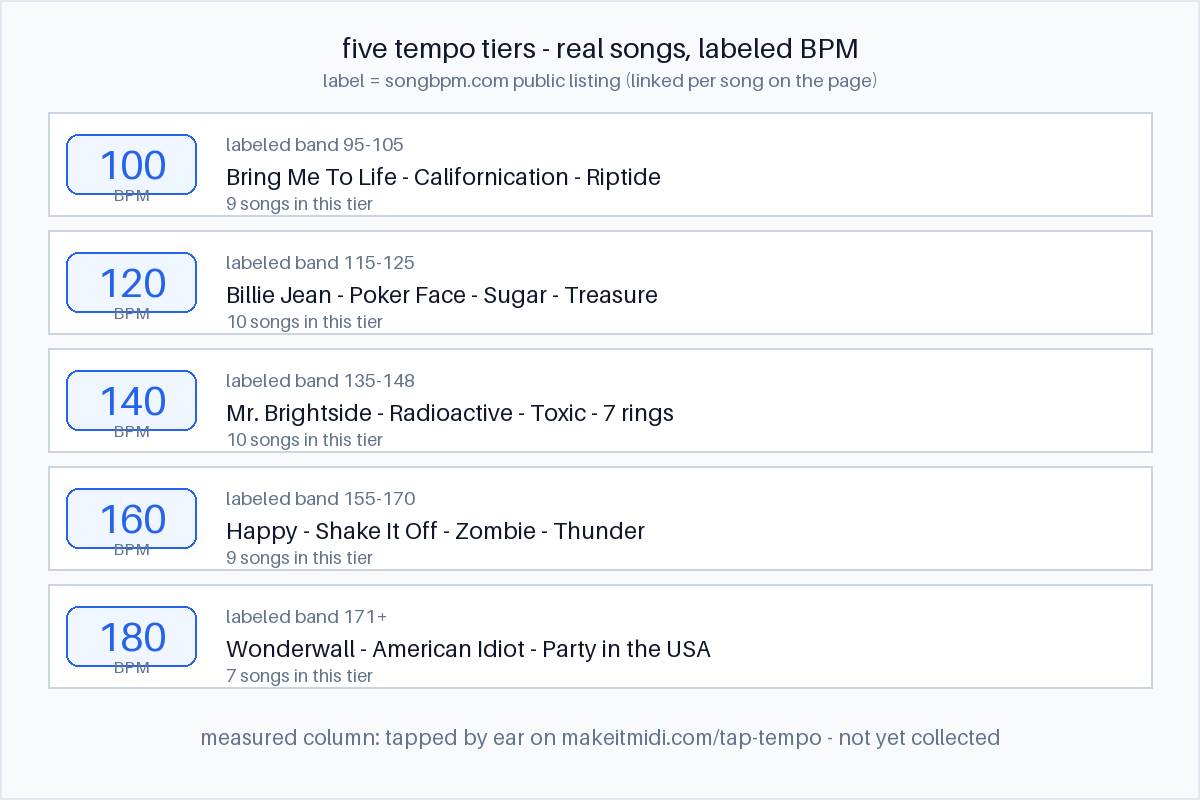
- Bands. 100 = 95–105, 120 = 115–125, 140 = 135–148, 160 = 155–170, 180 = 171 and up. These are our ranges, chosen to keep famous songs from clustering uselessly at exactly 120.
- Song selection. Famous songs you can find on any streaming service, spread across decades and genres. No production-music library tracks — if you have never heard of the artist, it does not belong on this page.
Questions people ask
Why do two listings give different BPMs for the same song?
Three usual reasons: one counted the half-time or double-time layer instead of the main beat (the examples above come from the same public listings), one measured a live version or a remaster that runs at a different tempo, or a detector simply landed wrong. When two numbers differ by exactly 2× or ½, it is almost always the layer, not an error.
Why is the measured column empty?
Because we measure by ear, one song at a time, and an empty cell is more useful than a guessed one. Every number that appears in that column will have been tapped on our own pad. If you want to fill it in yourself, the pad is linked in every band above.
What do the band ranges mean?
They are our groupings, not a standard: 95–105, 115–125, 135–148, 155–170 and 171+. A song labeled 95 and a song labeled 105 share the first band on purpose, because at that speed the ear rarely tells them apart. The exact labeled value is in the table.
Can I use these BPMs in my DAW?
The labeled column is a published value you can cross-check against any public tempo listing. For anything you are going to commit to, tap the song yourself: your grid and your ear need to agree, and the pad gives you the value to two decimal places along with Half and Double for octave errors.
How do I know the labeled numbers were not made up?
The labeled column is a dated snapshot (2026-10-25) of public tempo listings, and the half-time and double-time pairs above are quoted from those same listings. The measured column is the part we produce ourselves — tapped by ear on our own pad, one song at a time.