- Nearest note (A4 = 440 Hz)
- A4 — 440.00 Hz
- Offset from that note
- exactly on the note
- MIDI note number
- 69
- Octave
- 4 — middle C is C4, and A4 is the A above it
Calculated in your browser from the number you typed. Nothing is uploaded — the math runs on your device.
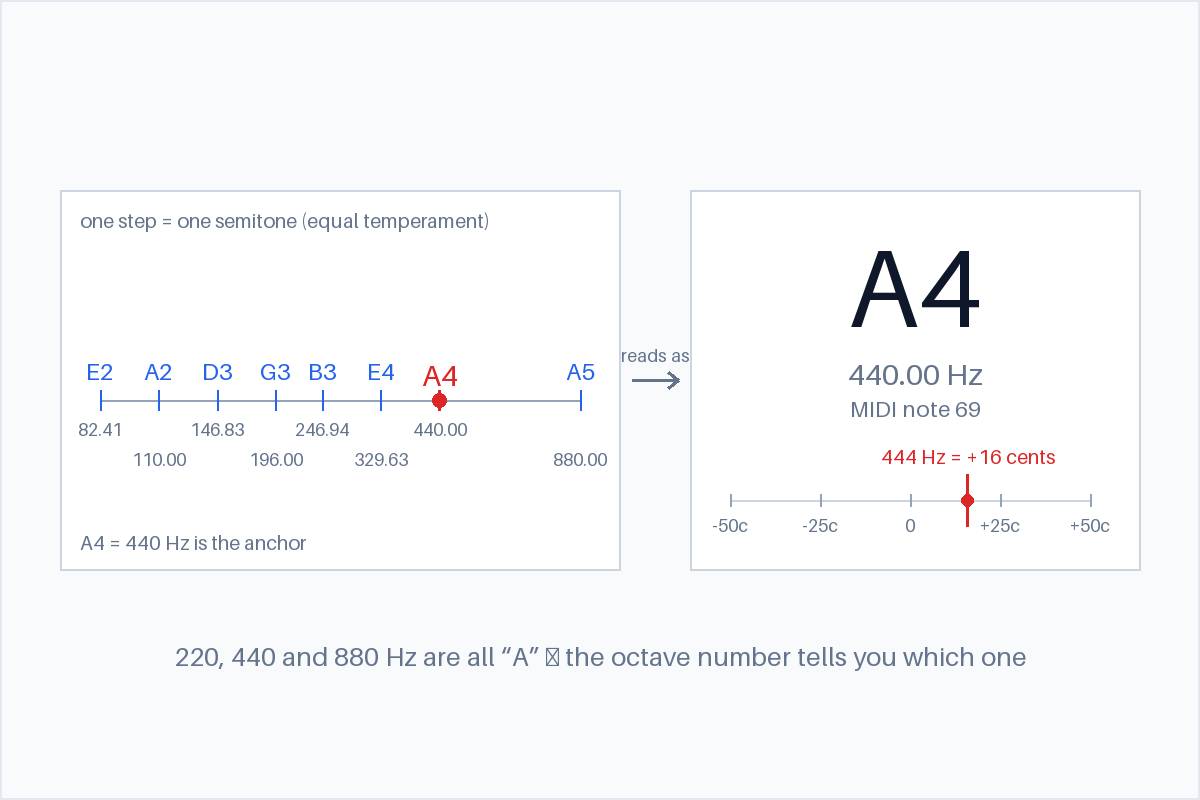
How a frequency becomes a note name
Notes are frequencies, and the naming system is arithmetic. One octave up doubles the frequency; one octave down halves it. Each octave is split into 12 equal semitones, and every semitone multiplies the frequency by the same factor — the twelfth root of two, about 1.0595. Multiply by that factor twelve times and you are back at exactly double the frequency.
Anchor one point and the whole system falls out of it. The standard anchor is A4 = 440 Hz, the note orchestras tune to. From there, the MIDI note number of any frequency is:
MIDI note = 69 + 12 × log2(frequency ÷ 440)
Round that to a whole number and you have the nearest note: 69 is A4, 60 is C4 (middle C). A few exact values worth remembering, all derived from the same anchor:
- C4 (middle C) = 261.63 Hz
- A4 = 440.00 Hz
- C5 = 523.25 Hz
- A5 = 880.00 Hz
The converter above runs exactly this math on the number you type — the same formula, in your browser.
Why 220 Hz, 440 Hz and 880 Hz are all called “A”
Note names repeat every octave, so one letter covers a whole family of frequencies an octave apart: 220, 440 and 880 Hz are all an A. What separates them is the octave number — A3, A4, A5 — where A4 is the 440 Hz anchor and middle C is C4.
This is the most common mix-up with frequency-to-note tools: the letter is right but the octave looks wrong. If a tool says your 220 Hz tone is “A”, that is correct but incomplete — the octave is what tells you which A. The converter above always shows the full name with its octave, plus the MIDI note number, so there is no ambiguity about which frequency family you are in.
What the cents number means
A semitone is divided into 100 cents, so the cents figure is the fine-grained part of the answer: how far the frequency sits from the nearest note, in hundredths of a semitone. Positive means sharp (above the note), negative means flat (below it).
- 444 Hz reads as A4, +16 cents sharp
- 445 Hz reads as A4, +20 cents sharp
- 432 Hz reads as A4, −32 cents flat (against the 440 Hz reference)
That offset matters more than the note name in real work. Two takes of the same sung note can both come back “A4” and still not sit together — the cents figure is what tells you they are 15 cents apart. It also explains why note-based conversion of bendy material sounds wrong: a pitch that is bending does not sit on any single frequency at all, so a detector has to round a moving target to the nearest semitone. That rounding is the mechanism behind out-of-tune MIDI, and we wrote up why it happens separately.
Reference frequencies worth knowing
| Sound | Note | Frequency (A4 = 440 Hz) |
|---|---|---|
| Middle C | C4 | 261.63 Hz |
| Orchestra tuning note | A4 | 440.00 Hz |
| One octave above middle C | C5 | 523.25 Hz |
| Low E, bass guitar | E1 | 41.20 Hz |
| Guitar strings, standard tuning | E2 · A2 · D3 · G3 · B3 · E4 | 82.41 · 110.00 · 146.83 · 196.00 · 246.94 · 329.63 Hz |
Every number in that table is derived from the A4 = 440 anchor — change the reference and they all move together. Music recorded or tuned to a different reference will read sharp or flat against this table by a corresponding number of cents, which is exactly what the converter’s cents readout shows. This page does not claim one reference is better than another; it states the anchor it uses and reports the offset.
Questions people ask
What note is 440 Hz?
A4. 440 Hz is the standard tuning reference — the A above middle C — which is why this converter anchors on it: every other note’s frequency is derived from that one point.
What frequency is middle C?
C4 = 261.63 Hz when tuned with A4 at 440 Hz. If a recording uses a different reference, middle C sits at a slightly different frequency, and the cents readout shows the difference.
Is 432 Hz an A?
At the A4 = 440 reference it reads as A4 about 32 cents flat. Whether it counts as “A” depends on the reference the music was tuned to — the math does not change, only the anchor does.
Why does my note read a few cents sharp or flat?
Real instruments and voices drift around a center pitch, and a single frequency reading is a snapshot of a moving target — vibrato and bends move the pitch continuously. A few cents of offset on a live performance is normal, not an error in the math.
Does this page upload my frequency?
No. The conversion is arithmetic that runs entirely in your browser; this page makes no network requests with your input.