← Back to the MP3 to MIDI converter
How do I transcribe a song to MIDI?
Drop the song into a browser converter and it writes the lead melody as a Standard MIDI File — one melodic line, decoded and analyzed on your device, with no upload and no login. What it does not do is split the finished mix into separate instrument tracks in one pass.
What "transcribe a song to MIDI" actually means
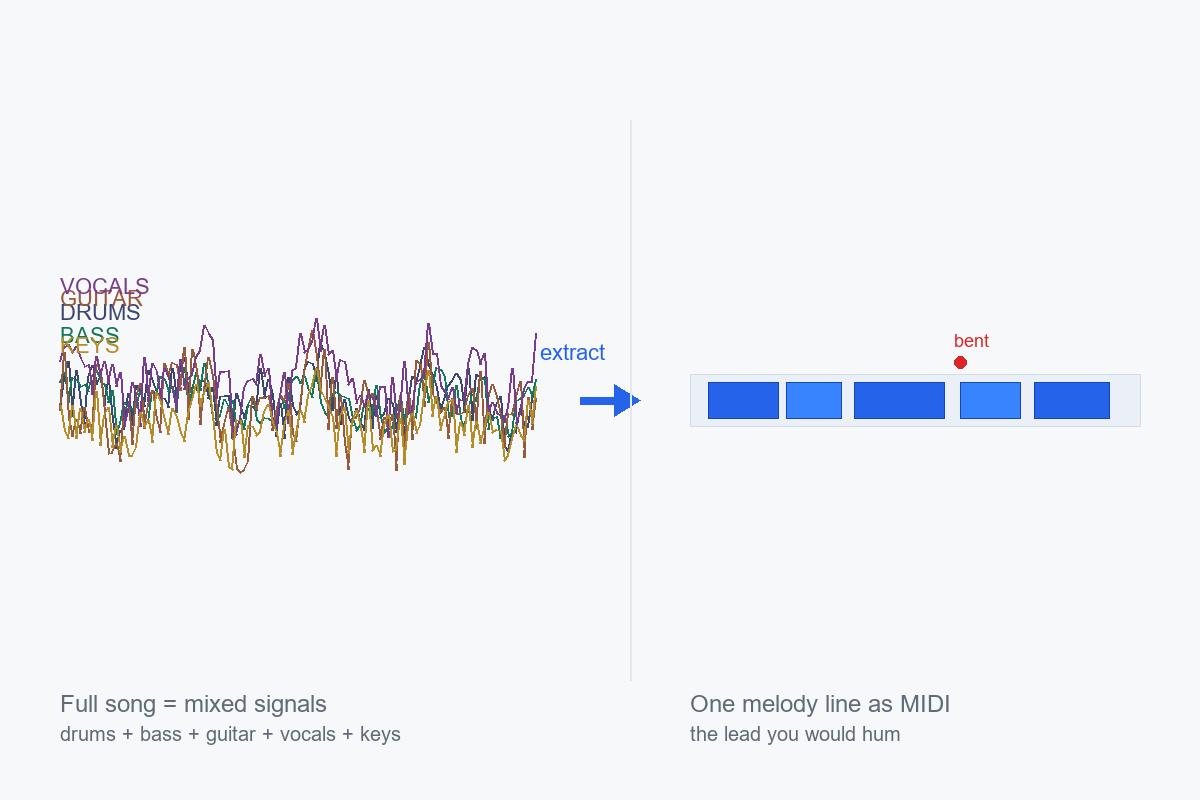
Transcription here means capturing the notes — pitch and timing — as MIDI events, not producing audio. A song file is a finished mix: drums, bass, guitar, vocals, and keys all stacked on top of each other. A simple audio-to-MIDI converter does one job — it listens to that combined sound and follows the strongest melodic line it can track, which is the tune you would hum. It is writing note events, not separating the instruments into their own tracks.
So the honest expectation is: you get a usable lead melody, often good enough to rebuild the rest by hand in your DAW. You will not, from a single mixed recording, get a clean multi-track score in one step. If you need "every instrument as its own MIDI," that is stem separation plus transcription — a heavier pipeline than a one-click converter runs. Knowing that up front is what makes the result useful instead of disappointing.
How the browser converter does it
The converter on this site runs entirely in your browser. The audio is decoded and analyzed on your device, nothing is uploaded, and there is no account to sign in to. Drop an MP3 (or WAV, OGG, M4A/AAC, or FLAC), press convert, and download a Standard MIDI File.
The output is SMF format 0: a single track, 480 ticks per quarter note, at 120 BPM. There is no file-length or size limit written into the page — only whatever your device's memory allows. It extracts one melodic line from the audio; on a busy mix that line is the dominant melody, not a per-instrument breakdown. That keeps the tool honest and fast. No accuracy percentage is printed, on purpose: the result depends entirely on the source you feed it, and any number we printed would be a guess. What we can state is exactly how the output is built and where its limits sit. Once you have the .mid, import it into whatever DAW you already use and finish the arrangement there.
Why a transcribed song can sound out of tune — and why that is not a free-vs-paid thing
This is the part that surprises people, and it applies to every pitch-detection tool, AI-labeled or not. A detector has to round a continuously moving pitch into semitone note events. Any note that bends, slides, or wobbles (vibrato) gets snapped to the nearest semitone, so it lands sharp or flat even when the pitch was detected correctly. Microtonal material that sits between the twelve notes of equal temperament gets pulled to the closest one. Worst cases: guitar bends and wide vibrato, vocal slides and runs, blues and soul bent notes, sustained string vibrato, and any microtonal playing land out of tune almost by definition. Clean solo piano or a steady synth lead, by contrast, comes out fine.
So the honest framing is: it is not that a free tool is "worse" than a paid one. In producer forums the complaints about out-of-tune output attach to free browser tools and the $80 desktop options alike — even the well-rated paid tools leave the correction work to you. On a bend-heavy song, choose by running a clip of your own through a trial and watching what it does with the bends, not by whether it is free. Then fix the few bent notes by ear, reach for a cleaner source, or use a single-note correction tool like Melodyne — and treat the converter output as a draft: rhythm, contour, and a skeleton to finish the last 20% yourself.
Turning the MIDI into a finished arrangement
We do not claim what any third-party DAW or editor does internally, so the route that works everywhere is the same: get a .mid from a converter, then import that file into the software you already use. Convert first, import second. From there you layer your own drums and bass, quantize the timing, and correct any bent notes by ear — the MIDI is a starting point, not a final mix.