← Back to the MP3 to MIDI converter
Can MP3 to MIDI convert chords?
Not as separate notes — a browser converter like this one extracts one melodic line, so a chord collapses into a single note at a time (usually the loudest voice, sometimes a false low tone), never the three or four notes you heard sounding together.
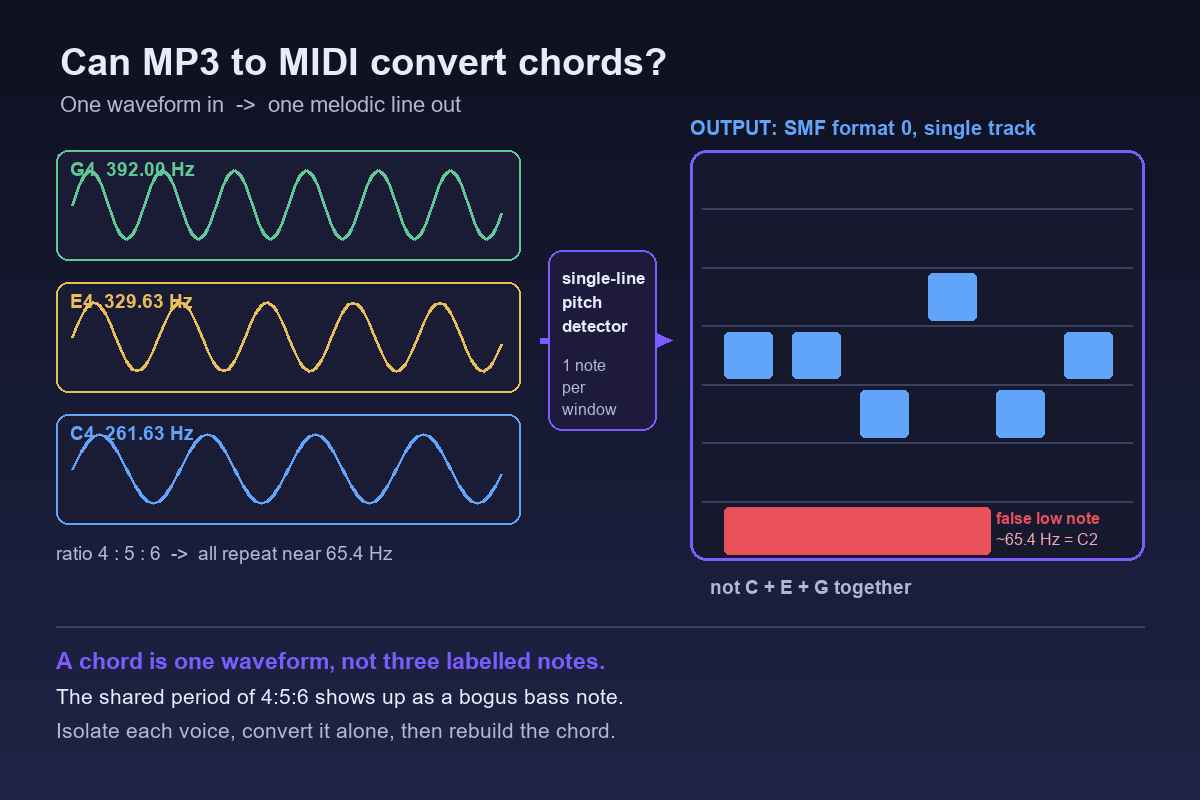
What you actually get when you feed it a chord
The output is a Standard MIDI File (SMF) format 0, single track, 480 ticks per quarter note, at 120 BPM. It contains a sequence of note events — one note number, one start time, one duration at a time. It is a transcription of a single melodic line, not a chord-by-chord or instrument-by-instrument separation. Feed it a C major triad and you will not get C, E and G as three simultaneous MIDI notes; you get one of them, or a note that is none of them.
Everything behind that runs inside your browser: the audio is decoded locally, the pitch is detected locally, nothing is uploaded, there is no account and no login, and you download the .mid directly. MP3, WAV, OGG, M4A/AAC and FLAC all take the same path. The code sets no file-length or file-size limit; only your device memory does. No accuracy percentage is published here, because the result depends entirely on the source — any single number printed would be a guess.
Why a chord cannot come out as three notes
The interesting part is not "the tool is too simple". It is that a chord does not contain three pitches in the form a detector can read. A microphone or a mixed audio file holds one pressure waveform. A single-line pitch detector looks at a short window (tens of milliseconds) and asks one question: what is the fundamental frequency repeating here? A chord has several fundamentals sounding at once, so that question has no single answer, and the detector must pick one.
You can see exactly what it picks with a bit of arithmetic. A just-intoned major triad sits at the frequency ratio 4 : 5 : 6. Take C4 (261.63 Hz), E4 (329.63 Hz) and G4 (392.00 Hz). Because all three are close to integer multiples of 65.4 Hz, the combined waveform repeats roughly once every 1/65.4 s. A period-based detector finds that as the strongest repetition and reports approximately 65.4 Hz — C2, two octaves below the lowest note actually played. This is why dense chords so often produce a bogus bass note instead of a wrong-but-plausible melody note. The false pitch is not random noise: it is the shared period the three real notes create together.
Two more things stack on top. Harmonic overlap interleaves the overtones of every note, so the loudest partial in the window may belong to a different voice from bar to bar — the detected line jumps between chord tones. Masking lets a bright synth, a bass note or a drum transient take over whole phrases, so the voice you wanted quietly disappears. None of this has a fix inside a one-note-per-window detector, because the input simply does not contain one pitch. For a measured look at what happens as chords get denser, see why MIDI from polyphonic and dense mixes is inaccurate.
Why even the surviving line drifts out of tune
Suppose you isolate one voice and get a clean single-line result. It can still sound wrong, and the reason is separate from polyphony. MIDI note numbers are whole semitones. During a pitch bend, slide, ornament or vibrato, the true fundamental travels continuously between semitones. The detector has to round each frame to the nearest note, so the frames inside the bend get written down as the "wrong" notes — a short run of alternating neighbours where you expected one sustained pitch. Microtonal material is pulled onto the nearest semitone for the same reason, because it falls outside the twelve-tone grid entirely.
This is worst on guitar bends and wide vibrato, vocal slides and melisma, string vibrato, and blues or soul phrasing, where pitch motion is the whole point of the performance. It is nearly absent on clean, isolated piano single notes and a steady synth lead, where the pitch sits still. Practical handling: look at the detector's spectrogram for where notes glide or carry grace notes and correct those positions by hand, choose a cleaner source, use a single-note-mode editor for the awkward phrases, and accept that a bend-heavy take is a draft rather than a finished transcription.
One thing worth being blunt about: this is a limit of pitch detection itself, not a "free tools are worse" problem. In community threads people do not complain that the free converter is free; they describe the same drift on paid converters costing $80. If you are choosing a tool, the useful question is how it lets you handle bends, not whether it charges.
How to get chords into MIDI anyway
The reliable route is to stop asking one pass to do polyphony. Isolate or split the track into voices first, convert each single line on its own pass, then stack the resulting MIDI tracks in your DAW. Three clean monophonic passes rebuilt into a chord beat one messy polyphonic guess every time. If you only need the lead line, convert that line alone and add the remaining chord tones by hand — a triad is two extra notes, not a re-transcription.
For any DAW or notation editor, the step that always works is the same: convert the audio to a .mid file first, then import that file. We deliberately do not claim that any particular program does or does not offer audio-to-MIDI conversion built in. We have not verified that against an official source for every version, and guessing about someone else's feature list would be worse than giving you a route that works everywhere. Once the .mid is in your editor, the piano roll is where you rebuild the harmony and fix the stray notes.