← Back to the MP3 to MIDI converter
Does MP3 to MIDI keep the original BPM?
No — the .mid you download is written at a fixed 120 BPM and carries no tempo map from the song; you set the real speed in your editor after importing the file.
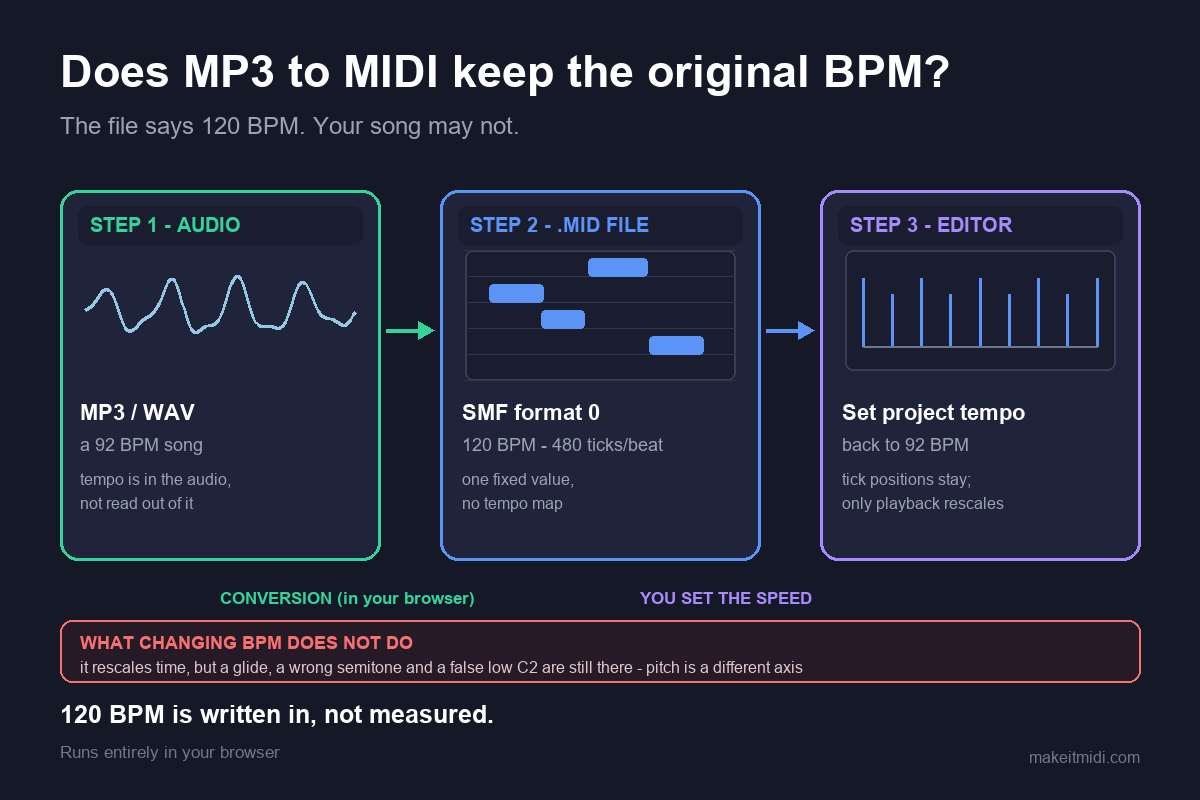
What tempo is actually written into the file
Drop an MP3 on the converter and you download a Standard MIDI File (SMF) format 0: one track, 480 ticks per quarter note, at 120 BPM. Its note events carry a note number, a start time and a duration, and the start times are stored as integer tick offsets. There are no barlines, no time signature and no tempo curve. The number 120 is not a measurement of your song. It is a constant the file is written with: in a Standard MIDI File, tempo is stored as microseconds per quarter note, and 120 BPM corresponds to 500000 of them. One beat lasts 0.5 seconds, one tick about 1.04 milliseconds.
That distinction matters when you want to change the speed. Tempo is a multiplier on the whole timeline, not a property of each note. Set the file to 92 BPM and every tick simply takes longer to play; the tick positions of the notes do not move, and not one note number changes. Speed and note content are two separate layers. Changing the first cannot repair the second, which is the part most "wrong BPM" complaints are really about.
Everything that produces the file runs inside your browser: the audio is decoded locally and the pitch is detected locally, the audio never leaves your device, there is no upload, no account and no login, and you download the .mid directly. MP3, WAV, OGG, M4A/AAC and FLAC all take the same path. The code sets no file-length or file-size limit — only your device memory does. What it transcribes is a single melodic line, not a chord-by-chord or instrument-by-instrument separation. We publish no accuracy percentage, because the result depends entirely on the recording you feed in; any single number would be a guess. To be equally plain about tempo: we do not auto-detect it, the file carries no tempo map, and we do not claim it lines up with the original. That is information the conversion never had, not a feature withheld from a free tier.
Why the converter does not estimate tempo
Estimating tempo is a different job from transcribing pitch. It means reading the onset envelope, finding a steady pulse, measuring the gap between beats and computing 60 divided by seconds-per-beat. This site does have a separate BPM Finder tool that does exactly that, but it is its own page and its reading is not fed into the converter. The converter's path only turns detected pitches into note events; it does no beat tracking at all. Saying that out loud is more useful than implying a hidden step that would make the exported speed look "recovered".
There is a reason not to write an estimated number into the file. A finished MP3 is a flattened mix, and plenty of music has no steady pulse to find: rubato playing, free-tempo introductions, accelerando and ritardando, sparse percussion, or an unaccompanied voice. On those, any BPM value is a guess dressed up as a fact. Writing a definite 120 and letting you set the real speed yourself is the same honest posture as refusing to print an accuracy percentage. A number you can replace in two clicks is more useful than one you have to distrust.
Here is the structural point that is easy to miss: tempo is the time axis, pitch is a different axis. Suppose the original was 92 BPM and you set the imported file to exactly 92. The notes now last as long as they should, the phrase sits in the right place, and every wrong note is still wrong. The errors come from rounding a continuously moving fundamental frequency into semitone-sized note events, and that rounding happens before any tempo is written. No amount of speed matching touches it.
How to line the file up with your song
The reliable sequence is short and does not depend on any one program:
- Get the
.midfirst. Drop the audio on the converter, press Convert to MIDI, then Download .mid. This is the only step that needs the original audio. - Find the song's real tempo separately. Count it by ear, tap along with a tap tempo tool, or run the file through a dedicated BPM tool. Do not expect the
.midto hand it to you — it was written at 120 by construction. - Set that tempo in your editor before judging the notes. In your DAW, notation program or piano-roll view, set the project tempo to the value you found. The tick positions stay put; only playback speed changes. If the song speeds up or slows down, you will need the editor's tempo map rather than one static number.
- Then work on the pitches. Once the timing matches, the remaining problems are note-level ones, and they need note-level fixes.
We deliberately do not claim that any particular program does or does not offer audio-to-MIDI conversion built in, or that it changes tempo in a specific way. We have not verified that against an official source for every version, and guessing about someone else's feature list would be worse than giving you a route that works everywhere. The step that always holds is the same: convert the audio to a .mid file first, then import that file. Once the notes are in your editor, the tempo field and the piano roll are where you rebuild the timing.
Why fixing the tempo does not fix wrong notes
MIDI note numbers are whole semitones. During a pitch bend, slide, ornament or vibrato, the true fundamental frequency travels continuously between semitones. A pitch detector has to round each short analysis frame to the nearest note, so frames inside a bend get written down as the "wrong" notes — a little cluster of neighbours where you expected one sustained pitch. Microtonal material is pulled onto the nearest semitone for the same reason, because it falls outside the twelve-tone grid entirely. Even when a converter writes proper pitch bend events alongside the notes, the note layer still had to commit to a base semitone first; bending a wrong note smoothly leaves you with a smoothly wrong note.
This is worst on guitar bends and wide vibrato, vocal slides and melisma, string vibrato, blues and soul phrasing, and microtonal music, where pitch motion is the whole point of the performance. It is nearly absent on clean, isolated piano single notes and a steady synth lead, where the pitch sits still. The other classic surprise is a bogus bass note. A just-intoned major triad sits at the ratio 4 : 5 : 6: C4 (261.63 Hz), E4 (329.63 Hz) and G4 (392.00 Hz) are all close to integer multiples of 65.4 Hz (divide by 4, 5 and 6 respectively), so the combined waveform repeats roughly once every 1/65.4 s. A period-based detector locks onto that shared repetition and reports about 65.4 Hz — C2, two octaves below the lowest note actually played. Set the tempo to 92, 120 or 173 and that false low note is still there: it is the arithmetic of three real notes overlapping, not a timing error.
One thing worth being blunt about: this is a limit of pitch detection itself, not a "free tools are worse" problem. In community threads about converters, the recurring complaint is that pitch bends make the output sound out of tune — not that the tool was free, and not that it exported the wrong BPM. People describe the same drift on paid converters costing around $80. If you are choosing a tool, the useful question is how it lets you handle bends, not whether it charges or whether it prints an impressive tempo value.
Practical handling: look at the detector's spectrogram for where notes glide or carry grace notes and correct those positions by hand, choose a cleaner source, use a single-note-mode editor for the awkward phrases, and accept that a bend-heavy take is a draft rather than a finished transcription. A clean single-line source gives the detector one pitch to follow; a dense, bent mix gives it several competing ones. Getting the BPM right is worth doing — it just is not the step that makes the notes right.