← Back to the MP3 to MIDI converter
Does MIDI carry audio?
No. A MIDI file contains no sound whatsoever — only instructions: which note, when, how hard, and for how long. Whatever you hear when you play one back is being produced by something else.
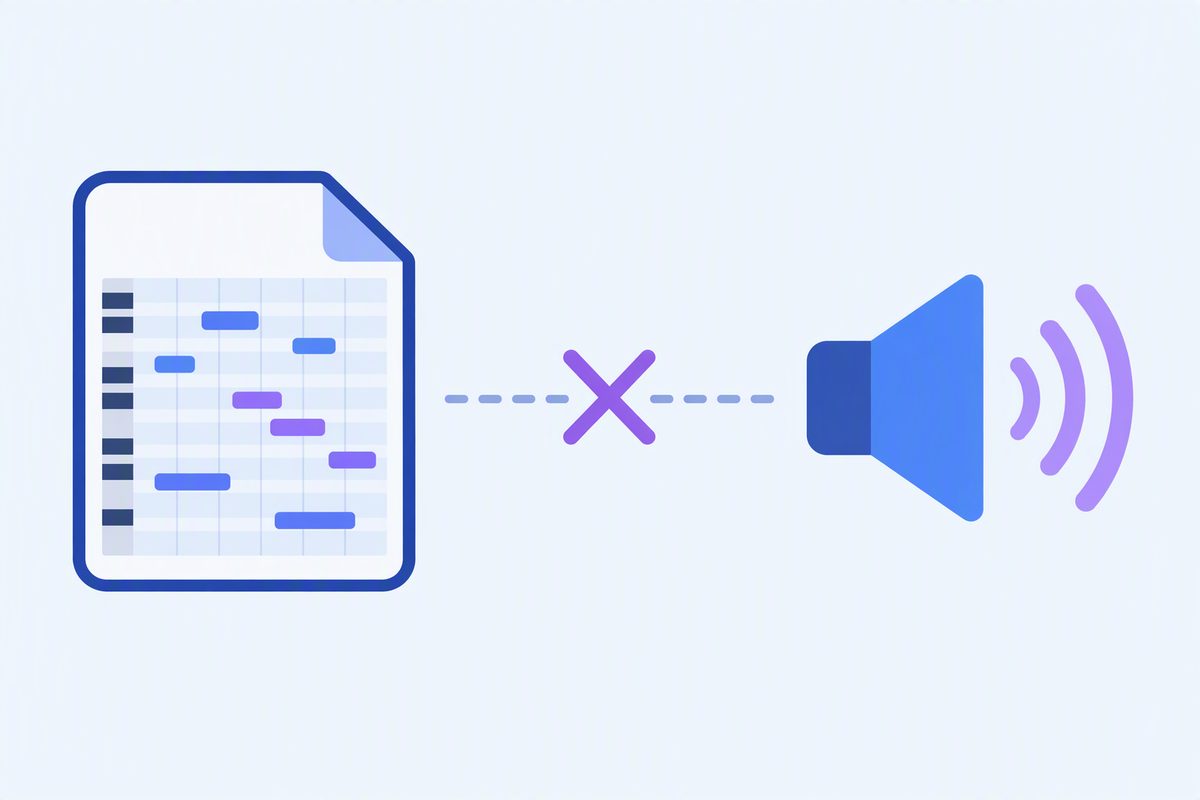
What's actually inside a MIDI file
Events. A note-on event carries a pitch number and a velocity, a note-off event ends it, and timing data places both on a grid. There is also metadata — tempo, track structure — but no waveform and no samples. That's the whole reason MIDI files are tiny: a three-minute piece is a few kilobytes, whereas the same three minutes of audio would be megabytes.
The file this page produces is a Standard MIDI File, format 0, single track, 480 ticks per quarter note, 120 BPM. It contains the detected melody line as note events and nothing else.
Why the same MIDI sounds different everywhere
Because the file doesn't decide the sound — whatever plays it does. Open one .mid in a
DAW with a piano loaded and you hear a piano; point it at a synth and it's a synth; load it into
MuseScore and it prints as notation. Same instructions, different performer.
This is the most useful property MIDI has, and it's a direct consequence of carrying no audio. It's also why people are sometimes disappointed: they expect the converted file to sound like the original recording, and it can't, because the recording's sound was never written down — only its notes were.
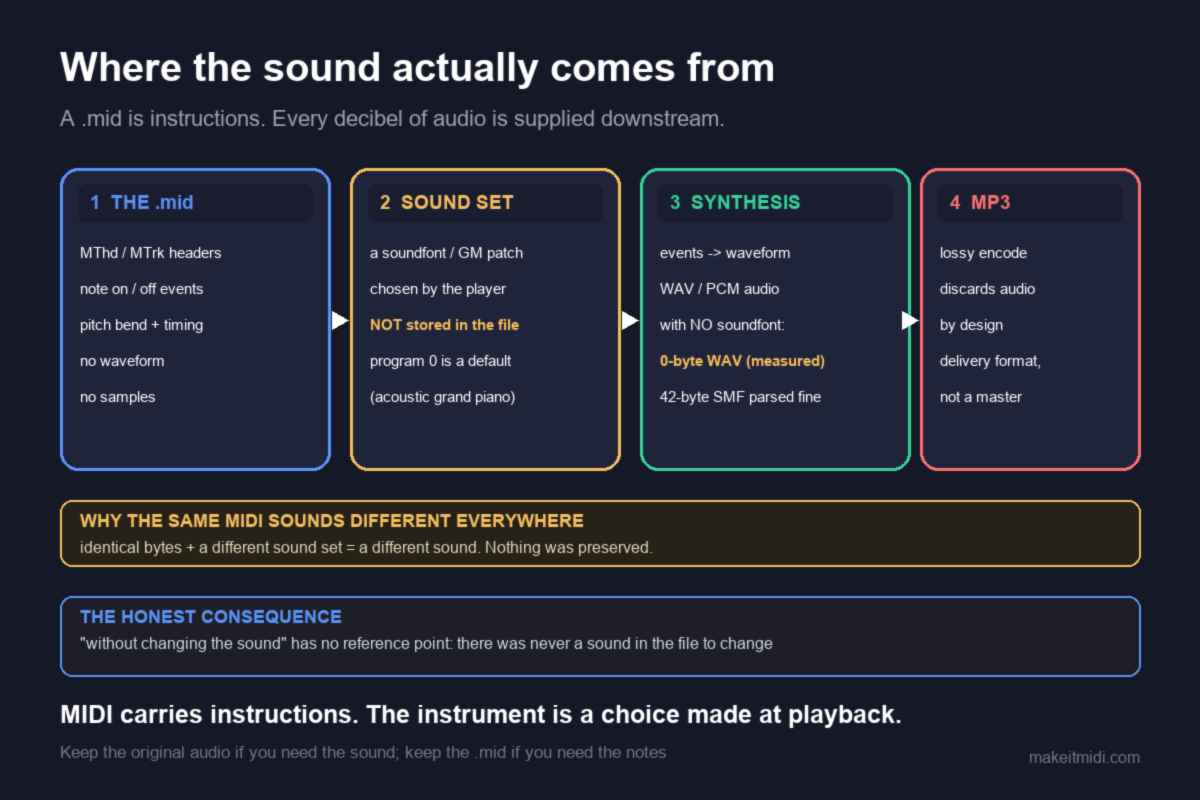
So where did the voice go?
It was never in the data. A pitch detector estimates which note is being sung; the timbre, the breath, the room — none of that survives, because MIDI has nowhere to put it. If you need the actual sound, keep the audio. If you need the notes, MIDI is the right format, and that's the trade you're making.
Practical consequences
- MIDI is editable in a way audio isn't. Wrong note, wrong timing, wrong instrument — all fixable after the fact, because they're just numbers.
- You can re-instrument freely. The melody you extracted from a vocal can be played by anything.
- File size is negligible, so MIDI is cheap to store, send and version.