← Back to the MP3 to MIDI converter
How well does violin to MIDI work on a bowed recording?
A steady, single-string passage converts into a usable one-line MIDI melody. Almost everything else about the violin fights the converter: vibrato, shifts, portamento, double stops and intonation that was never equal-tempered all keep the pitch moving, and a monophonic detector has to commit every moment to one of twelve semitones. The violin is the hardest common instrument for this job — not because the tool is free, but because a bowed string rarely sits still on a note.
What you actually get from a violin recording
You get a single melodic line — one note at a time, no separate bow and body tracks, no double stops. The conversion runs entirely in your browser: the audio is decoded locally with the Web Audio API, nothing is uploaded, and there is no sign-in. The download is a Standard MIDI File (SMF) format 0: one track, 480 ticks per quarter note, a default tempo of 120 BPM, holding the detected melody. Any format your browser can decode works — MP3, WAV, OGG, M4A/AAC, FLAC — and the page has no length or size cap written into it; the real limit is your device’s memory.
Two things about that output matter for strings. First, 120 BPM is the file’s default tempo header, not a measurement of the recording — the notes land where they land in time, and you set the tempo afterwards in your DAW. Second, because the file carries notes and no timbre, the violin disappears the moment it becomes MIDI. What survives is the line: which pitch, when, for how long.
Why the violin is the worst case, not just a hard case
Every expressive thing a string player does is a change in the instantaneous fundamental frequency. A detector has to answer “which note is this?” at every moment, so a moving pitch becomes a series of wrong answers rather than one wrong answer:
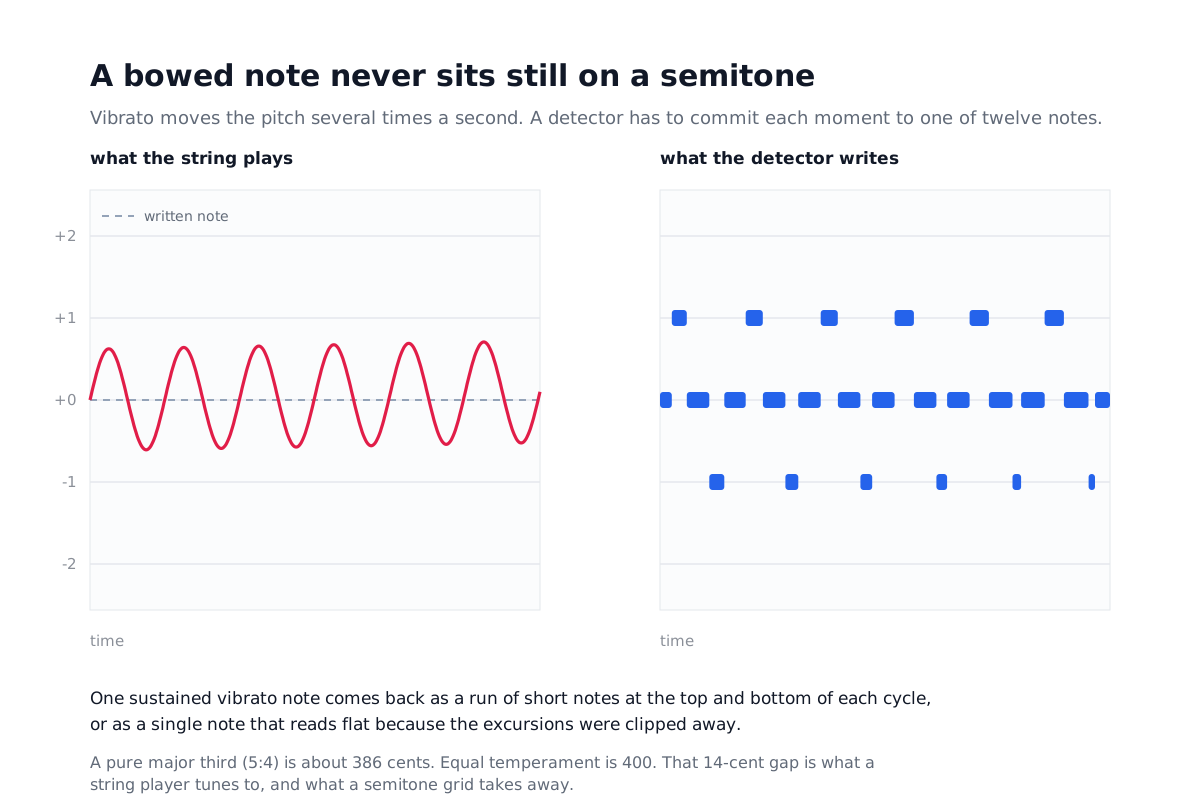
- Vibrato. A player oscillates the pitch several times a second, typically somewhere around 5–7 cycles, by a width that can exceed a quarter tone. The detector hears the top of each cycle as a different semitone from the bottom, so one sustained note can come back as a string of short notes, or as a note that is flat on average because the excursions were clipped.
- Shifts and portamento. Moving the hand between positions sweeps the pitch continuously. The sweep gets crushed onto whichever semitones it passes through, which is why a shift can appear as a fast run of notes that nobody played.
- Double stops. Two strings at once is polyphony. A monophonic detector keeps the more prominent pitch and drops the other, so a double stop turns into a single note and the interval disappears.
- Intonation that was never equal-tempered. This is the one people misdiagnose, and it gets its own section below.
- Bow noise and rosin. The scrape at the start of a note is broadband noise with no stable pitch. It can delay the onset the detector reports, which shows up as notes that start slightly late.
The general version of this wall, for any dense or polyphonic source, is on the polyphonic and dense mixes page. The string-specific version is the next two sections.
The octave problem: why bowed notes jump twelve semitones
The single most confusing violin result is a note that comes back exactly one octave too high. It looks like a random bug; it is a predictable consequence of how period-based pitch detection works.
A detector that measures period is looking for the repeat time of the waveform. For a pure tone there is only one candidate. A bowed string is not a pure tone: the bow drives the string into a rich harmonic series, and the strength of each harmonic depends on where the bow sits between the fingerboard and the bridge, how much pressure is used, and how close the finger is to the bridge. Move the bow toward the bridge and the upper harmonics get stronger while the fundamental can weaken. If the second harmonic ends up more prominent than the fundamental, the waveform repeats twice per cycle of the true note — the measured period halves — and the detector reports the pitch one octave up. Nothing malfunctioned; it locked onto the strongest periodicity in the signal.
Two practical consequences. High positions on the E string and any bright, near-the-bridge playing are the most exposed, because that is where the fundamental is weakest relative to its overtones. And lossy encoding can push the same way: a codec that spends fewer bits on low frequencies can tilt the balance further toward the harmonics. If you see octave jumps, the fix is manual — transpose those notes down twelve semitones — not a second conversion.
The intonation problem: the detector is right and the player is right
Violinists do not play in twelve-tone equal temperament, and mostly they should not. A player tunes the open strings in pure fifths and then adjusts each note to the chord and to the line. That produces intervals that are measurably narrower or wider than the piano’s.
The clearest example is the major third. In equal temperament it is exactly 400 cents. A pure major third — the 5:4 ratio, which is what a string player’s ear reaches for when tuning a chord — is about 386 cents. That is a difference of roughly 14 cents, and 14 cents is not a rounding error: it is well outside the range where most listeners call a note in tune against a fixed reference.
So when the detector snaps that note to the nearest semitone, it is doing exactly what it was built to do, and the player is doing exactly what the instrument asks for. The MIDI then sounds wrong to the person who played it — the third sounds sharp, the leading tone sounds flat — even though neither side made a mistake. If you have ever exported a violin line and thought “that is not what I played,” this is usually the reason, and it is the same class of problem as the general out of tune complaint.
Getting a usable line out of a violin take
The variable you control is the performance you feed it, not the software tier. What works, in order of impact:
- One string at a time. Play the part as a single line. Any double stop is guaranteed to lose a note.
- Keep the take dry. No reverb, no room miking if you can avoid it. Reverb is the same signal arriving later and quieter, and overlapping tails are exactly what confuses note boundaries.
- Moderate the vibrato for the take. You are not recording the final performance; you are producing a pitch contour. A flatter, straighter take converts far better, and you can add expression back in the DAW.
- Slow down the hard passages. Fast passagework with shifts inside it is the worst input there is. Record at a slower tempo and set the tempo back in the DAW.
- Split the piece into phrases. Converting eight bars at a time makes the errors findable. One long take makes them a search problem.
After the conversion, fix in this order: octave jumps first (they are the loudest mistakes), then slides and shifts (delete the phantom run and draw one note), then the notes that sit a hair off because of intonation. Only then start building on top of the line. The same bend-and-vibrato logic applies to the guitar and vocal cases, and the mechanism itself is on the pitch bend page.
What this page will not do is promise that some other tool solves it. The limit lives in the signal: a moving pitch with stacked harmonics and a non-equal-tempered scale is a genuinely ambiguous input for a single-pitch detector. Judge any converter by how it handles the moving parts, not by whether it is free.
Convert a violin recording to MIDI